Showing posts with label Union Street. Show all posts

Monday, October 21, 2024

Recent Reads: "Dirt Don't Burn: A Black Community's Struggle for Educational Equality Under Segregation"

Image of the book cover of "A Black Community's Struggle for Educational Equality Under Segregation" (2023). It features a black and white photo of a Black woman standing in front of a wooden two-story structure.

I read a new-to-me book, Dirt Don't Burn: A Black Community's Struggle for Educational Equality Under Segregation, by Barry Harrelson and Larry Roeder. It came out last year, and it's all about education in Loudoun County, so it is the perfect thing to talk about here!

Dirt Don't Burn chronicles Black education in Loudoun County from the Civil War to the late 1960's, when the school system was forced to desegregate. It doesn't just cover education itself, but also the many facets that need to be met in order to have a thriving learning environment: health/sanitation, heating, nutrition, transportation, administration, funding, and teacher education. It also sheds light on the many sung and unsung heroes who championed the fight for better Black education, as well as the work, petitions, letters, and organizing those individuals accomplished.

This book was created by the Edwin Washington Project, a non-profit dedicated to documenting the impact of segregated education in Loudoun. They've done some fantastic work uncovering and preserving stories, data, and history that really hasn't been public knowledge. And this book demonstrates that. The Edwin Washington Project is a subsidiary of the Edwin Washington Society, which was created to foster non-partisan conversations about the value of diversity in modern society, usually with a history/preservation focus.

Back to the book. The book's emphasis is on Black education, but in order to truly explain the dichotomy between the separate education systems in Loudoun, white education also has to be defined, so it really is an overview of both. There is lots to glean from its pages, especially in the early years of public education in the county. This is a thorough book of information that explains the intricacies of Loudoun's early public education system and how it grew. I understand their scope was just covering segregation, but I wish their coverage of events continued beyond that point. While de jure segregation was put to an end, there are still areas of de facto segregation.

The Edwin Washington Society has said they have more books planned, so I look forward to seeing what they publish next. In the meantime, add Dirt Don't Burn to your reading list!


Dirt Don't Burn can be bought online in multiple places. It also is available at select bookstores around Loudoun County. I happened to find one at the Very Virginia Shop in Downtown Leesburg, and it turned out to be an autographed copy! Just goes to show, it never hurts to shop local! 

Tuesday, November 22, 2016

Union Street School Sees Possible Re-Use

Union Street School in Leesburg, Virginia

I love preservation and the re-use of sites. I also love the Union Street School in Leesburg.

So when I read in the LoudounNow that Alumni May Revive Former Union Street School, I got very, very excited.

I hope they are successful, it's a beautiful site that needs some love.


See & Read my Adventure into the Union Street School Here

Thursday, July 26, 2012

Gertrude Alexander

   Some would consider Loudoun County Public Schools to be a very progressive school system. While other organizations have only recently put females and minorities in seats of power, LCPS had a black and female superintendent in the late 30's.

   In 1939, Gertrude Alexander was put to the post as Superintendent in LCPS. But how is this possible right in the middle of both segregation and Superintendent Oscar Emerick's term (1917-1957)? Simple. She was superintendent of the African American side of the school system.

   According to this Balch Friends article, she was the person who recommended that all the smaller groups calling for a new black school join together under the County Wide League. Under the League, blacks finally got a non-firetrap high school building, Douglass High School (1941).

   She also invited Charles Houston to Loudoun to speak to the African American community for the first time. (I will properly cite this when I get back from vacation. Apologies). Houston, a famous lawyer, was also very instrumental in pushing for Douglass High School.

   Not much is known about Gertrude. No one at Balch Library can even find a picture of her. I don't know when her term ended or how did her superintendent position relate to Emerick's. This has just been an interesting nugget for you to chew on.

Wednesday, June 6, 2012

Recent Reads: "We Have Been Waiting Too Long"

Lord Loudoun 1966, LCHS Yearbook

   I don't know why I didn't stumble on this sooner. At Balch Library is a wonderful dissertation by Matthew Exline, a History Major at Patrick Henry College. It's full title is " "We Have Been Waiting Too Long," Civil Rights and the Death of Segregation in Loudoun County, Virginia."

   To rephrase the title, it covers the Civil Rights Movement in Loudoun County from 1917 to 1969.

   Just a forewarning: There are many sources out there already available, and I have not seen everything out there. That being said, I thought it was one of the best. The dissertation is the most complete journey of the county's civil rights movement I have read. With others, I got brief overall. This explained all the twists and turns, giving details on various struggles.

   The segregation of schools was a main part of Loudoun County's segregation. This dissertation devotes two out of its five chapters on the schools. Other chapters go over desegregating Purcellville Public Library, restaurants in Leesburg and Middleburg, and desegregation of recreational places in Leesburg.

   My favorite line: "Such crises usually involved Douglass High School, which was apparently in perpetual need of urgent attention." Poor Douglass!

   It even ends with a message about how "Even though the events may be partly forgotten, that does not mean that all the wounds are healed or all the wrongs have been righted." I think this is true at times. It did say that LCPS was the only branch that has admitted its previous wrongdoings. And LCPS will continue to again in the LCPS History Video we are working on.


   "We Have Been Waiting Too Long" is currently available at Balch Library. Balch is connected to the main Loudoun County Public Library System, so you can reserve the book from your closest library branch as well.


[Update 2020: Matthew Exline has now released this as a book! It is titled "We Have Been Waiting Too Long: The Struggle Against Racial Segregation in Loudoun County, Virginia." You can find copies to purchase here.]

Monday, August 15, 2011

Union Street School

What do you call a school with at least six different names?

Let's count the ways:
Loudoun Training School
Leesburg Training School
Loudoun County High School
Douglass Elementary School
Loudoun County Training School
Leesburg Industrial School

   I myself have given it a few more nicknames, calling it The white Black School on Union Street, or just plain Union Street.
   It's a headache, so say the least. (For this blog's purposes, I'm going to call it Union Street)


   Welcome to Union Street. In 1962, a brick admin building was built on the property, but before that, it was the site of Leesburg's black school. Let's first walk around the site.

The one story wing was built at a later date, I don't know when.


Only the windows on the front aren't boarded up.

The backyard, sporting great views of the cemetery

   Union Street was built approximately 1884. A Training School (as one of its names) was a derogatory term applied to black schools, saying it wasn't really a school but a training school, not in the same league as a white school. It was Loudoun's only black school that taught secondary education when it began offering the level in the 1910's (which is probably around the time it received the name Loudoun County High School. How does it compare with the originally white-only Loudoun County High School of 1954?)

   The building had no indoor bathrooms. There was an outhouse (now demolished). There was no cafeteria, no auditorium, and no library. It housed five classrooms. Its school equipment, especially for science, was lacking. The school was also a death trap.
"...the window opening on the fire escape does not even have sash cords, and the oil soaked floor and open oil drum under the steps leading to the second floor constitute a veritable death trap in case of fire."
                                      - Charles H. Houston letter to Superintendent Emerick, 3/16/1940
   The parents pushed and pushed for a new school. When Douglass HS opened in 1941, the high school students moved out...but the elementary school students stayed. Union Street was renamed Douglass ES. The conditions did not improve. In 1958, when the new Douglass ES was built, this facility finally closed as a school.

   For a few years, it was used by the National Guard, during which time toilets were installed in the basement. I don't know when they moved out or much about what Union Street was used for afterwards. Currently, the building is mostly empty, being used for a little bit of storage.

   One of my goals this summer working here was to get into this building. And it happened! Would you like to take a look inside?

Look! Electricity! It has life!

The Basement bathroom


Storage of old things

It was surprisingly clean in this room

Old Lights

   On the second floor:


A close-up on the door: "A little shove will do it"

   And, the lovely staircase:


   I like it. It's sad to see it like this. I wish a use could be found for this. It's sort of away from the epicenter of downtown Leesburg, so it's not in the best spot in the world (plus, it's next to the cemetery, that's always a bonus, right?). It would need a big renovation if it was ever to be used publicly again. I know what I'd do with it. Why not turn it into a LCPS history museum and offices? Blue sky idea, but it's historic enough and it doesn't have to be big.

   In 2003 during a school board meeting, it was recommended to give future consideration to Union Street in a "lease agreement to the County of Loudoun or Town of Leesburg for governmental/historic use." I don't know what was said or what actions were taken; or it is possible nothing happened, that it was forgotten about. The building sits.

   Geraline Johnson (a Union Street teacher who is still alive) said in a recent interview about Douglass ES (1958) that she would like if the building was used like the Second Street one-room schoolhouse in Waterford, a place where children could learn how school used to be and about segregation. Unlike one room schoolhouses, Union Street has five rooms, which could give it multiple uses.

   So if you have a couple of million of dollars to spare...
What would you do with Union Street?


Sources:
Geraline J Johnson interview (2011) for Frederick Douglass ES
Douglass HS 50th Anniversary booklet (1991)
"Piedmont Stories: Leesburg Teacher's Career Spanned Two Eras" from the Washington Post, 9/20/2009
"High Schools Once Flourished Across Area"  - Eugene Scheel, Washington Post, 9/21/2003
Charles H. Houston letter to Superintendent Emerick, 3/16/1940

A special thank you to Sara Howard O'Brien!!

Tuesday, August 2, 2011

The History of Administrative Spaces

They are not schools, but they are just as necessary. Administrative Offices are key to keep everything in the school system running smoothly.

So, here's my admin timeline. Tell me if I forgot anything.


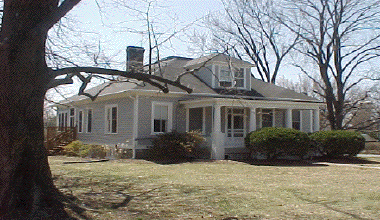
I'm going to start at Superintendent Emerick’s original office (1917): his home (corner of Orchard and Main St) in Purcellville. (Before this, admin was probably somewhere else. I don't know of anything before 1917 at this time.)

Photo of the front of a small gray cottage with a second floor dormer window in the roof. The front yard is mainly composed of grass, but there are trees and bushes also present.
(Picture from Emerick Elementary School site)

1918: the offices move to a space above N.G. Miller’s Purcellville Pharmacy
1935: offices move into an office behind the Loudoun County Courthouse (2nd floor in former Leesburg Academy building). It is basically two rooms and a walk-in closet.

Former Leesburg Academy Building
1962: The Union Street Admin Facility opens. It is the first facility built to be used as a school admin space. It is called the School Board Office/Main Office Admin Building. (Presently, it is the Child Find and Parent Resource Center)

Union Street is the brick building on the right.
(I'll talk about the building on the left later.)

1969 – 1971: Between holding Broad Run HS overflow/middle school students, Douglass HS is used for administrative offices. It is called the "School Board Annex." [This was a large jump in office square footage, while also continuing to own and use the one-story Union Street building. It is very possible other buildings were used/rented prior to Douglass' admin use, but I have not found any records]

Douglass School / Community Center

1971: Leesburg ES closes and becomes admin space. Its official name now is the School Board Annex Building, but eventually, it is called "North Street" after the road it is on.

North Street (picture from spring 2011)

1982: Douglass ES closes and is used as a support facility/admin space.

Douglass Support Facility

1988: A new central Admin Building is proposed by School Board to the Board of Supervisors. Construction funds for the building are excluded from following CIPs due to fiscal constraints, and the building is not built. 


1992: There is a structural analysis of the Union Street admin facility for feasibility of a second floor.

Another view of the Union St. Admin Building. It's tiny!

1998: 51 Plaza Street appears in the school directory. They are trailers on the Douglass Support Facility property. Along with this, Douglass Support's address changes from 3 Sycolyn Road to 55 Plaza Street.

51 Plaza Street trailer facility

1999: Round Hill School closes, and is reused as a support facility. The Staff Training Center (former Ashburn ES and BRHS Annex) appears in the school directory under admin facilities.

Round Hill Center

Staff Training Center
(We've gone over this)

2005: the Admin Building on Education Court in Ashburn opens. Everyone rejoices! Administration is now in one centralized location and space is plentiful. Its official name is the "Loudoun County Public Schools Administrative Building." (Homework to everyone: help give it a good nickname). North Street is vacated.
LCPS Administration Building

2006: 51 Plaza is vacated, and the trailers are sent down the road to be used by the Douglass School (the number "51" can still be found on the trailers).
2010-2011: North Street converts into a Senior Center (it opens this fall! Check it out!)
2011: Douglass Support is closed and demolished for a new F. Douglass ES.

Douglass Support Facility in the middle of demolition

(There are also spaces that aren't necessarily admin spaces, but they are support facilities. The Warehouse (1989), The Valley Service Center (2002), the Maintenance Facility (2002), and the Bus/Transportation Facility (1991) are all current support buildings. The Annex building at Loudoun County HS (1954) used to be a bus warehouse, but has since been given over to be used by the school.)

Despite many a move, LCPS administration has been supporting Loudoun schools for many a year. Thank you for all that you do.

 Sources:
CIPs
Construction Dept files
School Directories
"A Brief History of Loudoun Schools"